
Life event guides
As a resident in Denmark, you may find yourself in a situation where you need to deal with many different public authorities and private organisations. In such cases, it can be a challenge to keep track of everything you need to know and remember to do.
Life event guides on borger.dk can help you navigate the digital public sector during different life events in order to ensure a good user experience.
It may be difficult to piece together what you need to do, who you need to contact, and in which order when moving, becoming a parent, getting divorced or preparing for retirement; all life events involving contact with several authorities. The guides on borger.dk aim to provide residents in Denmark with an overview of what one needs to know and do in different life events.
The main purpose of the guides is to make it easier for residents to navigate the public sector, experiencing coherence and a better service.
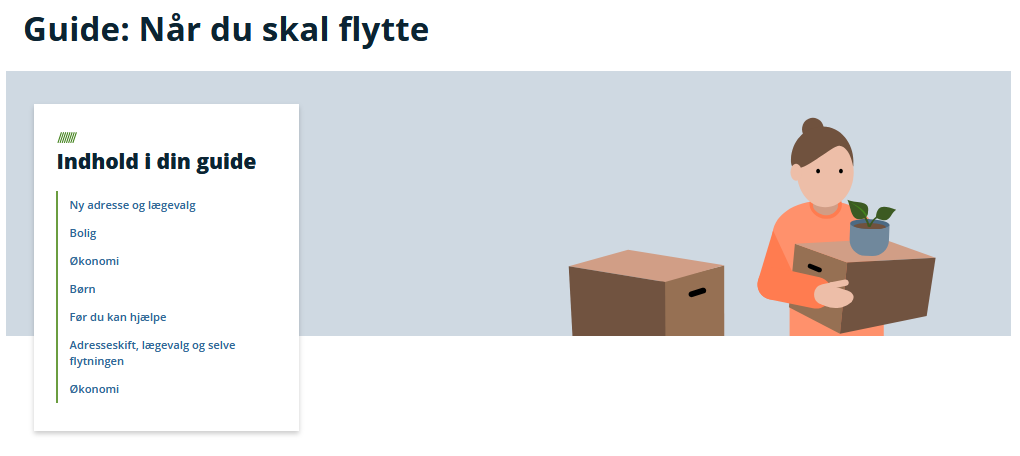
Example from the guide on moving in Denmark.
Life event guides
A number of guides have been created to help residents during these different life events:
- Moving
- Moving abroad
- Moving to Denmark
- Retiring
- Death of a relative
- Becoming a parent
- Losing a job
- Getting a new job
- Becoming a digital citizen (13-17 years old)
- Getting divorced
- Starting higher education
- Be granted Power of Attorney to assist another person
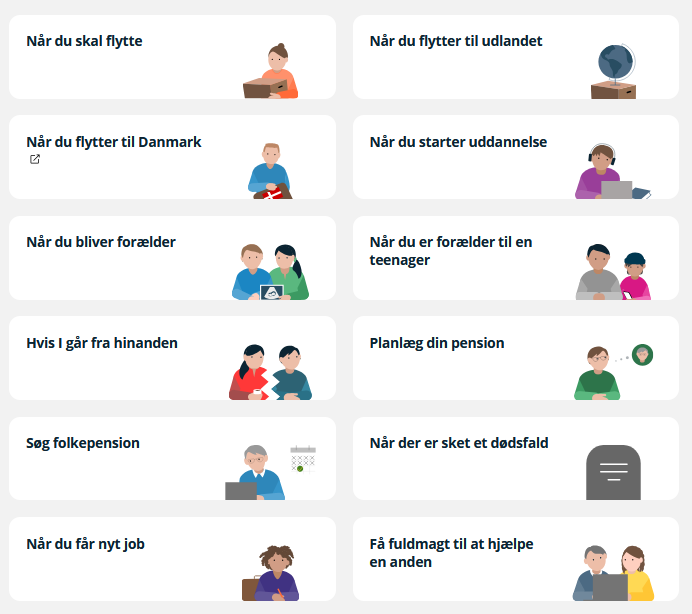
The guides can be found on the Danish National Citizen Portal borger.dk.
The thoughts behind the life event guides
The life event guides can be found at borger.dk. They have a different layout than the other pages on borger.dk, which emphasises that the guides are a collection of information from different public authorities within the same life event.
Five central aspects of the guides:
- The scope of the information provided in the guides is broad, containing information on many topics and areas, for instance relevant links for further in-depth reading, or links for applying for benefits.
- Most of the guides begin with one or more introductory questions about the situation of the resident. This helps adjust the information shown, thus making it more specific and relevant for the specific resident and their situation.
- The construction of the text often highlights what the resident needs to know and what to do (including important deadlines) and what happens automatically.
- Each guide contains all the different aspects one has to deal with in a given life event, for instance concerning health, children, finances, tax and insurance.
- The guides do not require log on, and no data about the resident is collected.
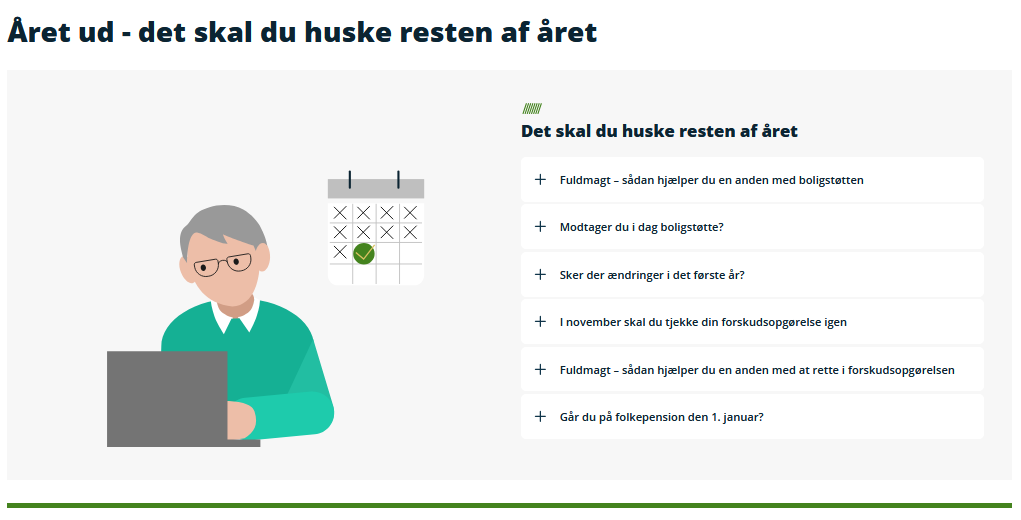
Example from the guide on retiring.
An inclusive and participative process
In order to create the guides, relevant authorities have been extensively involved and have contributed with knowledge and fact checking of content.
Contact
Do you have any questions about the life event guides on borger.dk?
Please write to us on: